Wellness waves
For over 180 years, Cunard has championed the restorative power of ocean travel, and as the results of a recent study undertaken by the Company show, the positive impact of Cruising can be backed by science.
Ground-breaking research conducted by human understanding agency Walnut on Cunard’s flagship, Queen Mary 2, confirms that just five days at sea can positively impact various cognitive abilities, such as memory, logical reasoning, perceptual abilities and problem solving, demonstrating that the iconic Transatlantic Crossing significantly benefits mental and emotional wellbeing.
In a first-of-its-kind neuroscience study, the results revealed that Cunard’s Transatlantic Crossing, combined with the associated programme of enriching experiences, can increase cognitive abilities by 26%, making guests more alert, focused, and resilient.
The sample:
- 40 guests travelling on the Westbound Transatlantic voyage sailing on 17th October 2024 from Southampton to New York
- 25 men and 15 women
- 22 of the sample was under 64
- Predominately British and American participants
- 60% were first time cruisers
Fieldwork
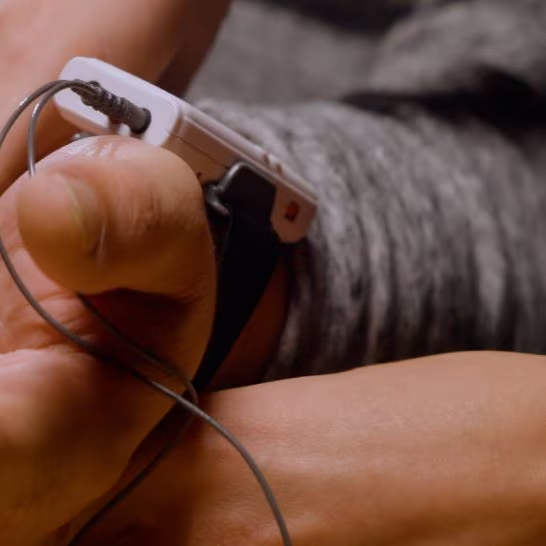
Walnut tested a number of cognitive abilities using biometric tools to measure cognitive and physiological changes before and after five days at sea. These tools were a neurofeedback device, which captures brain’s electrical activity, and Galvanic Skin Response (GSR) measurements, which capture physiological arousal through changes in skin conductance produced by sweat.
The neurofeedback device measured participants’:
- Ability to relax on demand
- Emotional response to imagery
- Performance in cognitive tasks surrounding memory, attention, logical and spatial reasoning, and creativity
The GSR measured participants’ responses to qualitative and quantitative questions about their wellness and mood.
As mentioned above, the tests were conducted both before and after five days at sea to see whether responses changed between sessions.
Results
The results were remarkable, showing notable improvements in memory, problem-solving, attention, and overall emotional wellbeing.
Better relaxation and lower stress levels – The study found that both conscious and objective measures of stress indicate higher relaxation after the cruise. Guests consciously reported feeling better, and those telling us they had been “feeling relaxed’ increased by 158%. Moreover, overall stress levels reduced by 35% on average, as indicated by physiological arousal levels.
Better performance – The test discovered an average 26% increase in cognitive abilities such as memory, logical reasoning, perceptual abilities and problem solving.
- Memory: A successful recall of words increased by 29% (from 4.8 words to 6.18), indicating enhanced short-term memory performance
- Problem-solving: Logical and spatial reasoning accuracy increased in the most complex task set by 125%
- Attention: 14% improvement in focus during visual tasks
Physiological wellbeing and emotional responses – The study saw physiological indicators that reflected the 26% increase in performance on cognitive tasks, on average it showed a 7% increase in attention, 4% increase in engagement and a 24% decrease in stress levels during the cognitive tasks. Notably, after only five days on board, guests displayed a greater ability to cope with high cognitive load in the most complex logical task set: with physiological measures of engagement increasing by 28% and stress dropping by 29% for the most complex task
Puppies usually trigger a strong emotional reaction in the brain, after travelling on the QM2 for five days guests’ brains showed the same emotional response to cruises as they did to puppies (both scoring above the average benchmark for positive brain engagement at 57%) with high cognitive load after their time on board; with physiological measures of engagement and attention increasing by 28% and 4%, respectively, and stress dropping by 29%.
Neuroscientist Dr. Jack Lewis, commented, “What stands out for me in this study is how neatly all the pieces fit together. The passengers time on the ship clearly reduced their stress levels, based on subjective and objective measures. The main stress hormone cortisol is well-known in the science research literature to interfere with various cognitive processes.
“So, the boost in memory and logical reasoning capacity identified in this study is likely to be attributed to the stress-relieving impact of ocean travel. This combined with the amazing array of stimulating activities on board… allows the passengers brains to unlock their full potential.”
Beyond the study’s cognitive findings, Cunard’s unique offering provides an unmatched sanctuary for relaxation and renewal. From captivating lectures by world-renowned experts as part of the Cunard Insights programme to personalised wellness treatments, each element of the voyage is thoughtfully designed to foster wellbeing. This is all complemented by the Company’s celebrated White Star Service, ensuring every moment aboard is distinguished by personalised attention and elegance.
This post appears in its original form here: https://www.cunard.com/en-gb/cunard-stories/wellness-waves and includes links to further elements which may be of interest to you.